Transforming Forgotten Discs into Everyday Treasures
Old CDs often accumulate in drawers, boxes, or forgotten corners, remnants of a time when physical media was the primary way to enjoy music, movies, and software. With the rise of streaming services and cloud storage, these discs have lost much of their practical value, frequently becoming clutter that few know how to handle responsibly. However, setting aside the frustration of managing outdated technology reveals a deeper significance: the need to address environmental concerns linked to disc disposal, the opportunity to reconnect with nostalgic objects, and the potential to unlock creative uses that breathe new life into these shiny, reflective surfaces. Understanding what can be done with old CDs is not only a matter of clearing space but also a chance to make thoughtful choices that benefit both the planet and personal creativity.
The environmental and cultural impact of discarded CDs
Once ubiquitous, compact discs now represent a quiet legacy of a different era of media consumption. Tens of millions of discs were manufactured and sold through the 1990s and early 2000s; many remain in closets, basements, and office boxes. Their sheer volume contributes to a lingering environmental footprint because most CDs are made from a mix of materials that do not break down easily in landfill conditions.
Materials used in CDs include polycarbonate plastic, a thin aluminium reflective layer, lacquer coatings, and printing or label inks. That mixture makes straightforward recycling difficult: facilities designed for plastic or metal streams are rarely equipped to separate and process the laminated layers. As a result, a large share of unwanted discs ends up disposed of with general waste rather than being recovered.
Municipal recycling programs vary widely in what they accept, and many do not handle optical media at all. Electronic waste policies have improved for batteries and large appliances, but small items like CDs and DVDs often fall into a grey area. Community recycling events and specialised processors sometimes accept discs, yet availability is inconsistent across neighbourhoods. Sustainability movements and repair cafes have pushed for reuse as an alternative to disposal, encouraging citizens to treat obsolete objects as resources rather than rubbish.
Beyond environmental concerns, CDs have cultural value. Collections once curated with care now feel obsolete, yet they capture moments in music, design, and personal history. Reconsidering how to treat these physical objects raises questions about consumption habits, how cultural memory is maintained, and how everyday clutter might be repurposed to reduce waste while preserving a connection to the past.
Practical reuse ideas for old CDs in everyday life
Old discs can be repurposed into useful, attractive household items with a little basic equipment and creativity. Surface reflectivity makes them ideal for projects that rely on light, while their rigid shape suits functional craft items. Simple conversions often require only common supplies such as strong adhesive, clear sealant, spray paint, felt pads and tools for drilling or cutting.
Here are accessible projects that convert unwanted discs into household helpers and decor. Each idea is followed by brief preparation notes to keep work safe and effective.
- Garden reflectors: Hang discs from string to deter birds and protect vegetable patches. Use a small hole punch or drill and tie with nylon cord. Weatherproof with a clear outdoor sealer if desired.
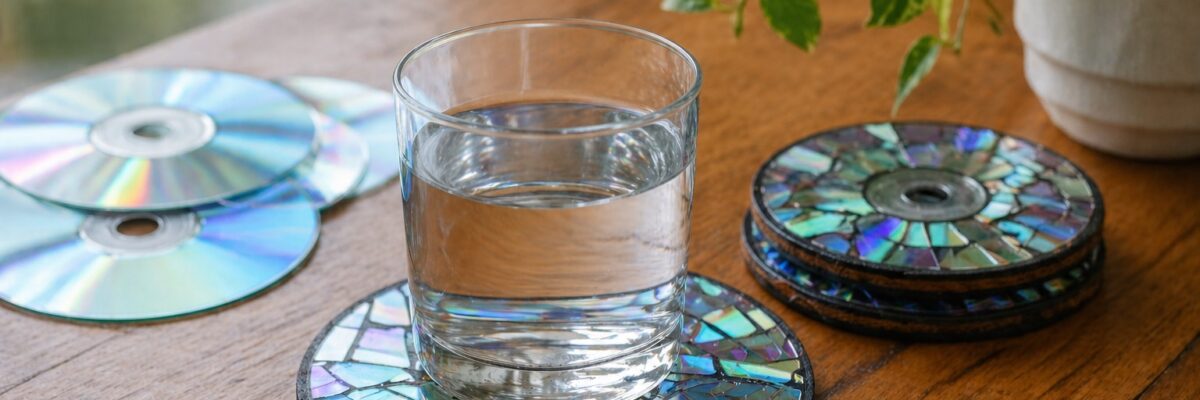
- Coasters and trivets: Glue felt pads to the underside of several stacked discs to protect surfaces from heat and scratches. Sealed painted surfaces can create attractive tableware without large expense.
- Decorative mosaics: Break discs into pieces using scored snaps or a rotary tool and arrange fragments into frames, trays, or mirror surrounds for shimmering wall features.
- Light catchers and suncatchers: Paint the non reflective side with translucent paints or adhere coloured cellophane, then hang in a sunny window to scatter shimmering colour across a room.
Safety and preparation matter. Wear eye protection and gloves when cutting or breaking discs. A rotary tool with diamond or abrasive bits will make clean cuts but requires steady hands and a workshop mask to avoid inhaling dust. If drilling, select a bit designed for plastics and support the disc on a wood block to reduce cracking. For painted finishes, clean the surface with isopropyl alcohol so paint or adhesive bonds well; a light sanding can improve adhesion for slick surfaces.
Repurposing offers practical benefits beyond waste reduction. Making coasters, garden markers or simple reflectors saves money and provides quick, satisfying projects suited to a range of skill levels.
Artistic and technological innovations using old CDs
Artists and makers have embraced old discs as a way to merge aesthetics with commentary on obsolescence. Shimmering mirrored surfaces create striking effects in sculptures and installations, while discs incorporated into clothing, jewellery or wearable art add texture and movement. Such practices turn everyday detritus into provocative design, often commenting on consumption and memory.
On the technological side, CDs can serve as inexpensive components for experiments and learning. The reflective layer and encoded spiral track make them useful for optical demonstrations, diffraction experiments and simple spectrometer builds for classrooms. Maker spaces often host workshops that repurpose discs in electronics and kinetic projects, combining artistry with hands on learning.
Small tools and basic electronics can expand possibilities. A soldering iron, LEDs, resistors and simple microcontroller boards let creators add light or motion to disc based pieces. Breadboards and low voltage power supplies are useful for prototyping interactive installations. Safety training and supervision are advisable for anyone unfamiliar with electrical work.
- Sculptural techniques: Heat shaping, layering and stitching discs together with wire create three dimensional forms that play with light and shadow.
- Interactive builds: Embedding small lights or reflective sensors allows discs to respond to movement or sound in installations.
Community workshops and maker spaces play an important role by providing tools, safety instruction and a collaborative setting. These environments encourage skill building and social exchange while reframing outdated objects as raw material for education and expression.
Donating, selling or upcycling CDs for social good and economy
Not every disc needs to be cut or painted. Many organisations accept used media that is still playable or can be repurposed whole. Libraries, schools, community centres and shelters sometimes take donations for educational use, language learning collections or craft supplies. Even clearly scratched discs can serve as craft material for group programs and fundraisers.
Secondhand markets remain viable for collectors and niche audiences. Online marketplaces, local flea markets and record fairs attract buyers looking for rarities, out of print albums or complete sets. Selling or trading a curated collection can support a modest income stream while extending the useful life of discs.
Preparing items for donation or sale increases their usefulness. Clean discs with a soft cloth, label packaging clearly and include condition notes. For shipping, use padded envelopes or small mailing tubes and consider basic storage supplies like sleeves, plastic cases and packing tape to present items safely and professionally.
- Places to offer CDs: local libraries, community arts organisations, adult learning centres, thrift stores and online secondhand platforms.
- What to include: a brief content list, condition notes and simple protective sleeves to make donated discs easy to store and distribute.
Charitable initiatives that collect media for fundraising or community art projects can transform surplus discs into social value. Donating or selling instead of discarding supports a circular economy and creates tangible benefits for neighbours and organisations that rely on low cost materials.
Synthesizing the value of old CDs in a digital age
Old discs function at the intersection of environmental consequence, creative potential and community opportunity. Their material composition poses disposal challenges, yet that same composition offers a reflective surface and rigid form that lend themselves to many second lives. Addressing how to handle unwanted discs encourages a resourceful mindset that finds value where many see obsolescence.
Adopting reuse strategies ranges from quick practical swaps to ambitious artistic or technological projects, and community networks expand the impact. Donations and secondhand markets channel material into social programmes and niche economies. Maker spaces and workshops turn reuse into skill development, while simple household projects provide immediate gratification and reduce waste.
Viewing old CDs as resources rather than refuse invites experimentation. Tools as simple as strong glue and felt, along with basic electronic parts or a rotary tool, open routes to new uses. Those with a collection to sort can choose a pathway that aligns with personal priorities: environmental stewardship, creative exploration or community support. Consider taking one box of discs, trying a small project or finding a local group that would welcome them, and share the results to inspire others to reimagine everyday objects.
Embracing the potential of old CDs beyond disposal
Engaging with old CDs through reuse and creative adaptation transforms what might be seen as clutter into meaningful resources. The practical, artistic, and social avenues explored highlight how these discs can retain purpose long after their initial function has passed. This approach encourages a mindset that values resourcefulness and rejects the idea that outdated technology is simply waste.
Choosing to repurpose, donate, or sell old discs fosters connections with local communities and supports sustainable habits. Whether crafting simple household items, experimenting with light and electronics, or contributing to shared projects, each action contributes to reducing environmental impact while nurturing creativity and social engagement.
Handling old CDs thoughtfully offers a way to engage with material culture in a manner that respects both the past and future. These objects carry stories and potential that extend well beyond their primary use. By considering practical reuse options and community opportunities, it becomes possible to turn a common disposal challenge into a source of inspiration, learning and tangible benefit.
References and Further Reading
- U.S. Environmental Protection Agency – Sustainable Materials Management: Electronics Donation and Recycling
https://www.epa.gov/smm-electronics - Ellen MacArthur Foundation – Circular Economy Introduction
https://www.ellenmacarthurfoundation.org/circular-economy/concept - StEP Initiative – E-Waste Problem Overview
https://www.step-initiative.org/e-waste-problem.html - United Nations Institute for Training and Research (UNITAR) – Global E-waste Monitor
https://ewastemonitor.info
Recent Posts
- How Hybrid Technologies Are Shaping the Future of Sustainable Driving May 7, 2026
- Unlocking the Power of Everyday Foods to Lower Cancer Risk May 6, 2026
- Rethinking Work and Wealth: How People Are Redefining Life Beyond the 9-to-5 May 5, 2026
- Finding Balance: Reclaiming Control in a World Dominated by Screens May 4, 2026
- Keeping Your Garden Healthy: Practical Ways to Stop Unwanted Plants from Taking Over May 3, 2026